
Question Types
The Glass platform currently offers question types that are adaptable to meet all your needs.
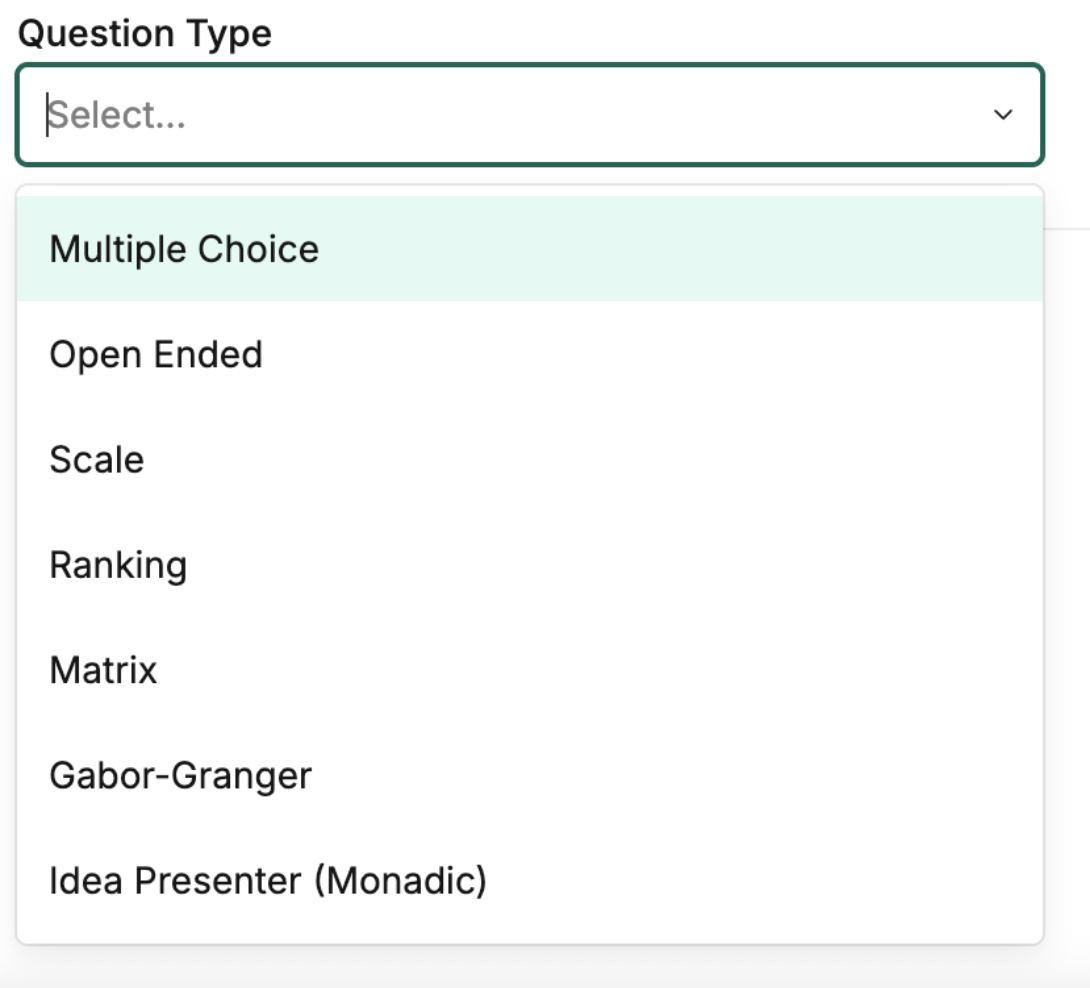
Question Type | The Basics |
|---|---|
Multiple Choice | Select one or more answers from a list of options. Easy to use options make this endlessly flexible, as you can specify:
|
Open End | Respondents write in the answer to your question. You can specify the format of the answer: text, numeric, an email address, etc. |
Scale | For each scale statement you create, respondents select an answer from a scale you design. You can specify the number of scale points, slider or radio buttons, or whether the scale must sum to 100%. Also used for bi-polar questions. |
Ranking | Rank options in order. You can specify how many options they must rank (top 2, all 5 in order, etc.). |
Matrix | For each matrix statement, respondents select an answer option. These are also called ‘grid’ questions, where respondents answer the question using rows x columns. You can specify the format: either an open grid or a drop-down list. |
Gabor Granger | Creates a series of questions using the Gabor Granger methodology to evaluate price elasticity and to identify the maximum price (or minimum discount) at which they’ll make a purchase. You may specify the relevant range and the metric (dollar, cents, ounces, %). |
Idea Presenter | Used to create a/b experiments through monadic design (by assigning respondents to view one of the ideas, images, or videos you upload.) You can specify the number of ideas respondents will be exposed to. Monadic experiments assign just one idea. Sequential monadic expose multiple ideas (one at a time), looping through each question for each idea assigned. |
Multiple Choice
Purpose: Use for single or multi-select responses — perfect for demographics, behavior, or brand awareness.
Pro Tip: Avoid forcing them to choose answers that do not apply by offering an “Other” or “None of the above” option.
Open Ended
Purpose: Capture unfiltered, qualitative feedback in respondents' own words.
Pro Tip: Keep your prompt clear and focused. Too broad = vague answers, too narrow = missed insights.
Scale
Purpose: Measure intensity or agreement using a numeric or Likert scale (e.g. 1–5, 1–10).
Pro Tip: Stick to the same scale format throughout your survey to make analysis easier and reduce confusion for respondents and your analysis.
Ranking
Purpose: Force prioritization of multiple items — helps uncover what truly matters.
Pro Tip: Limit to 5–7 items max. Anything more becomes a mental chore for respondents.
Matrix
Purpose: Ask about multiple items or attributes on the same scale — great for side-by-side comparisons.
Pro Tip: Use clear, concise row/column labels and avoid asking too many items at once — matrix fatigue is real. Try to use limited words, so respondents aren’t overwhelmed or required to do a lot of scrolling.
Gabor-Granger
Purpose: Identify optimal price points by testing willingness to pay at multiple levels. Understand price elasticity.
Pro Tip: Include a clear product description and visual to help respondents evaluate value consistently. Make sure you’re clear on trying to understand the maximum price to pay or minimum if needed (for a discount optimization).
Idea Presenter (Monadic)
Purpose: Show each respondent only one concept to reduce bias and allow isolated diagnostics across multiple questions. Perfect for testing methodologies.
Pro Tip: Randomize concept exposure across respondents and ensure each concept has identical structure for fair comparison.